All Categories
Featured


Serious Financial Results of 2026 Bankruptcy
Table of Contents
In filing a chapter 11, the debtor presents a strategy to lenders which, if accepted by the lenders and authorized by the court, will permit the debtor to rearrange individual, monetary or company affairs and once again become a financially productive individual or business.: Chapter 12 is developed for "family farmers" or "household fishermen" with "regular annual income." It enables financially distressed family farmers and anglers to propose and perform a plan to pay back all or part of their financial obligations.
Typically, the strategy should attend to payments over 3 years unless the court approves a longer period "for cause.": A specific with a routine income who is overcome by debts, but thinks such debt can be paid back within a sensible duration of time, may submit under chapter 13 of the insolvency code.
If the court authorizes the strategy, the debtor will be under the court's security while repaying such financial obligations. More info regarding the difference in between chapters can be found in the Bankruptcy Essential Manual.
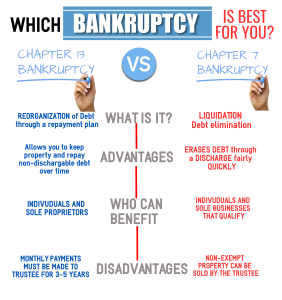
Numerous people in Michigan reach the point where they know they need relief, but they are stuck on one essential concern: should they submit Chapter 7 or Chapter 13? Selecting the incorrect course can have real effects for a house, a lorry, and a paycheck.
Picking Chapter 7 for Your 2026 Benefit
You would like to know what these chapters would really do to your financial obligations, your credit, and your everyday life. You might have heard buddies, coworkers, and even other lawyers offer strong opinions about one chapter or the other, typically without any reference of Michigan exemptions, regional trustees, or how your specific mix of financial obligations will drive the decision.
Both chapters originate from federal law, but they do not play out the exact same way for every single filer. Hensel Law Office, PLLC frequently deals with Michigan citizens to compare both chapters side by side utilizing real numbers, not generic checklists, and this post will reveal you how that analysis works and how to prepare for it.
When you file Chapter 7 in Michigan, an insolvency estate is produced that temporarily includes your non-exempt property, and a trustee is selected to evaluate your properties, income, and recent financial history. In many Michigan cases, exemptions cover everything the person owns, so the trustee does not sell anything, however that depends on your equity levels and the exemptions you use.Chapter 13 is various.
Key 2026 Bankruptcy Support and StrategiesStrategic 2026 Bankruptcy Support and Strategies
Both chapters are filed in the U.S.

However, Nevertheless exemption rules, local trustee regional, and common local typical regional change how alter Chapter 7 is for your property and how realistic Chapter Practical payments are for your household. Due To The Fact That Hensel Law Office, PLLC deals with both Chapter 7 and 13 cases in Michigan, the goal is not to push everybody into one chapter, however to match the chapter to the filer's real scenario.
The methods test compares your household earnings to the average earnings level for a family of your size in Michigan and then adjusts for specific permitted expenses. If your earnings is listed below the mean, you normally pass the means test. If it is above, a more detailed estimation of permitted expenditures and debts figures out whether a Chapter 7 filing would be presumed abusive.
You need to have a regular income, and your total secured and unsecured debts require to be within limits set by federal law. People often end up in Chapter 13 since their income is too high to conveniently pass the Chapter 7 implies test, due to the fact that they filed a prior Chapter 7 too recently, or because they are behind on a home mortgage or auto loan and need a structured way to catch up.
Protecting Wages From 2026 Garnishment
In Michigan, family structure matters. A married person whose spouse is not filing may still need to consist of some or all of the spouse's income in the methods test, and that can impact whether Chapter 7 is readily available. It is likewise typical for someone to technically receive both chapters from an earnings standpoint, yet find that their properties or financial obligation mix make one option clearly more secure.

Latest Posts

Long-Term Consequences of Declaring Bankruptcy in 2026

Is Chapter 7 Best for Your Needs?

Steps to Navigate a 2026 Bankruptcy Case