All Categories
Featured


Legal Support for 2026 Bankruptcy Filers
Table of Contents
In submitting a chapter 11, the debtor presents a plan to financial institutions which, if accepted by the lenders and approved by the court, will allow the debtor to reorganize personal, monetary or service affairs and once again end up being a financially productive person or business.: Chapter 12 is developed for "household farmers" or "household fishermen" with "routine yearly earnings." It allows economically distressed household farmers and anglers to propose and perform a plan to pay back all or part of their financial obligations.
Normally, the strategy needs to offer payments over three years unless the court authorizes a longer period "for cause.": An individual with a routine income who is overcome by financial obligations, however believes such financial obligation can be paid back within a reasonable time period, might submit under chapter 13 of the personal bankruptcy code.
If the court approves the strategy, the debtor will be under the court's security while repaying such financial obligations. More info concerning the distinction in between chapters can be discovered in the Personal Bankruptcy Fundamentals Handbook.
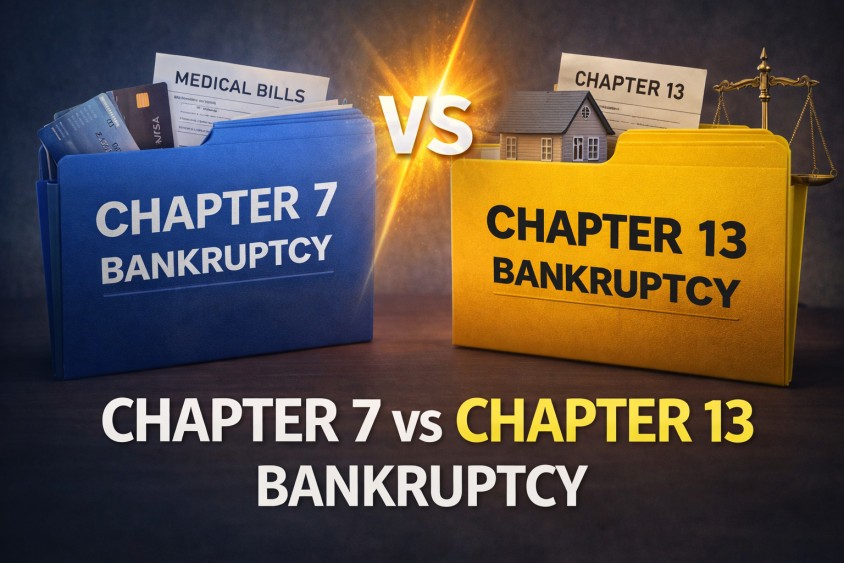
Chapter 7 and Chapter 13Lots of individuals in Michigan reach the point where they understand they require relief, but they are stuck on one crucial question: should they submit Chapter 7 or Chapter 13? Choosing the incorrect course can have real effects for a home, an automobile, and a paycheck.
Choosing Chapter 7 Vs Chapter 7 in 2026
You need to know what these chapters would actually do to your financial obligations, your credit, and your daily life. You may have heard friends, coworkers, and even other attorneys offer strong opinions about one chapter or the other, typically without any mention of Michigan exemptions, regional trustees, or how your precise mix of debts will drive the decision.
Both chapters originate from federal law, however they do not play out the same method for every filer. Hensel Law Office, PLLC routinely works with Michigan citizens to compare both chapters side by side using genuine numbers, not generic lists, and this short article will show you how that analysis works and how to get ready for it.
When you file Chapter 7 in Michigan, an insolvency estate is created that briefly includes your non-exempt residential or commercial property, and a trustee is appointed to examine your properties, income, and recent financial history. In many Michigan cases, exemptions cover everything the person owns, so the trustee does not offer anything, however that depends upon your equity levels and the exemptions you use.Chapter 13 is different.
Comparing Chapter 7 Vs Chapter 13 in 2026
Rather of concentrating on selling non-exempt properties, Chapter 13 centers on your future earnings. You propose a regular monthly payment that fits your budget plan which meets legal tests for paying secured, priority, and unsecured financial obligations. At the end of an effective plan, remaining qualifying unsecured financial obligations are released, much like in Chapter 7. Both chapters are filed in the U.S.
Nevertheless, Michigan-specific exemption guidelines, local trustee practices, and typical regional financial obligation patterns change how dangerous Chapter 7 is for your residential or commercial property and how realistic Chapter 13 payments are for your family. Because Hensel Law Office, PLLC deals with both Chapter 7 and 13 cases in Michigan, the objective is not to press everyone into one chapter, but to match the chapter to the filer's genuine circumstance.
The means test compares your home income to the mean income level for a household of your size in Michigan and after that changes for particular allowed expenditures. If your income is below the median, you generally pass the methods test. If it is above, a more comprehensive computation of enabled expenditures and financial obligations identifies whether a Chapter 7 filing would be presumed abusive.
You need to have a regular earnings, and your total protected and unsecured debts need to be within limitations set by federal law. People typically wind up in Chapter 13 because their earnings is too expensive to comfortably pass the Chapter 7 implies test, due to the fact that they filed a prior Chapter 7 too just recently, or since they lag on a home mortgage or vehicle loan and need a structured way to capture up.
Serious Financial Impacts of 2026 Bankruptcy
In Michigan, family structure matters. A married individual whose spouse is not filing may still require to include some or all of the spouse's income in the methods test, and that can affect whether Chapter 7 is available. It is also typical for somebody to technically get approved for both chapters from an earnings perspective, yet find that their assets or financial obligation mix make one alternative plainly much safer.

Latest Posts

Long-Term Consequences of Declaring Bankruptcy in 2026

Is Chapter 7 Best for Your Needs?

Steps to Navigate a 2026 Bankruptcy Case